
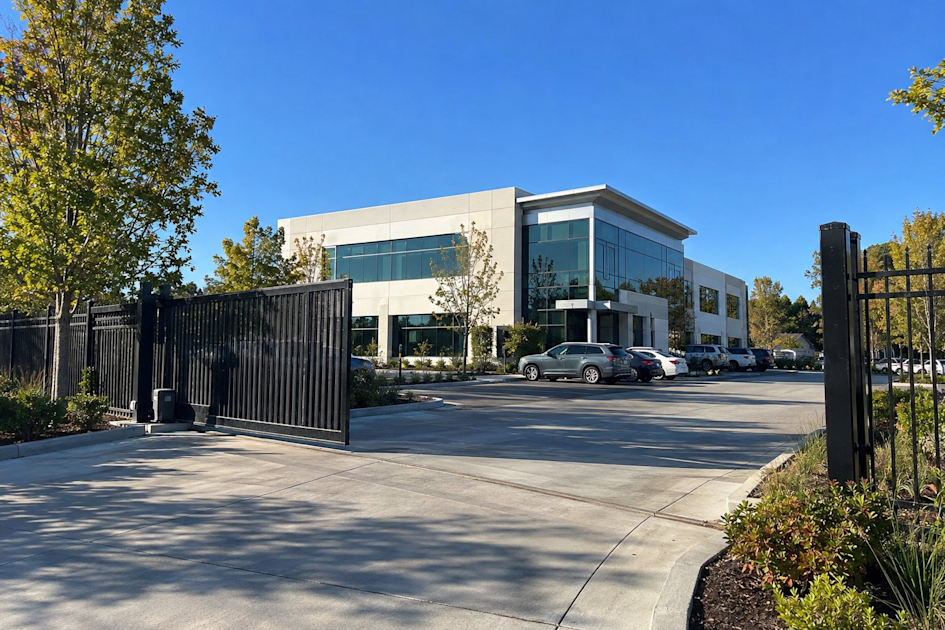


The short version: The right commercial gate comes down to how hard it gets used and the room you have to work with. Slide and cantilever gates handle wide openings and heavy daily traffic, swing gates suit offices and retail with room to arc, and barrier arms meter high-volume parking. Match the gate to your traffic, size a continuous-duty operator to the gate, and build it to UL 325 and ASTM F2200.
Picking a commercial gate comes down to one question nobody asks out loud: how hard is this thing going to get worked every single day? A gate at a 200-unit apartment complex opens and closes hundreds of times between sunrise and midnight. A gate at a quiet office park might cycle a few dozen times. Those are two completely different machines, even if they look similar from the street. Get the match wrong and you're calling for service every few weeks. Get it right and the gate basically disappears into the background, which is what you want.
So before you fall in love with a look, let's talk about the actual choices, because the gate style, the operator, and how the whole thing gets installed all have to line up with how your property runs.
The Four Commercial Gate Types and Where Each One Earns Its Keep
Most commercial jobs land on one of four configurations.
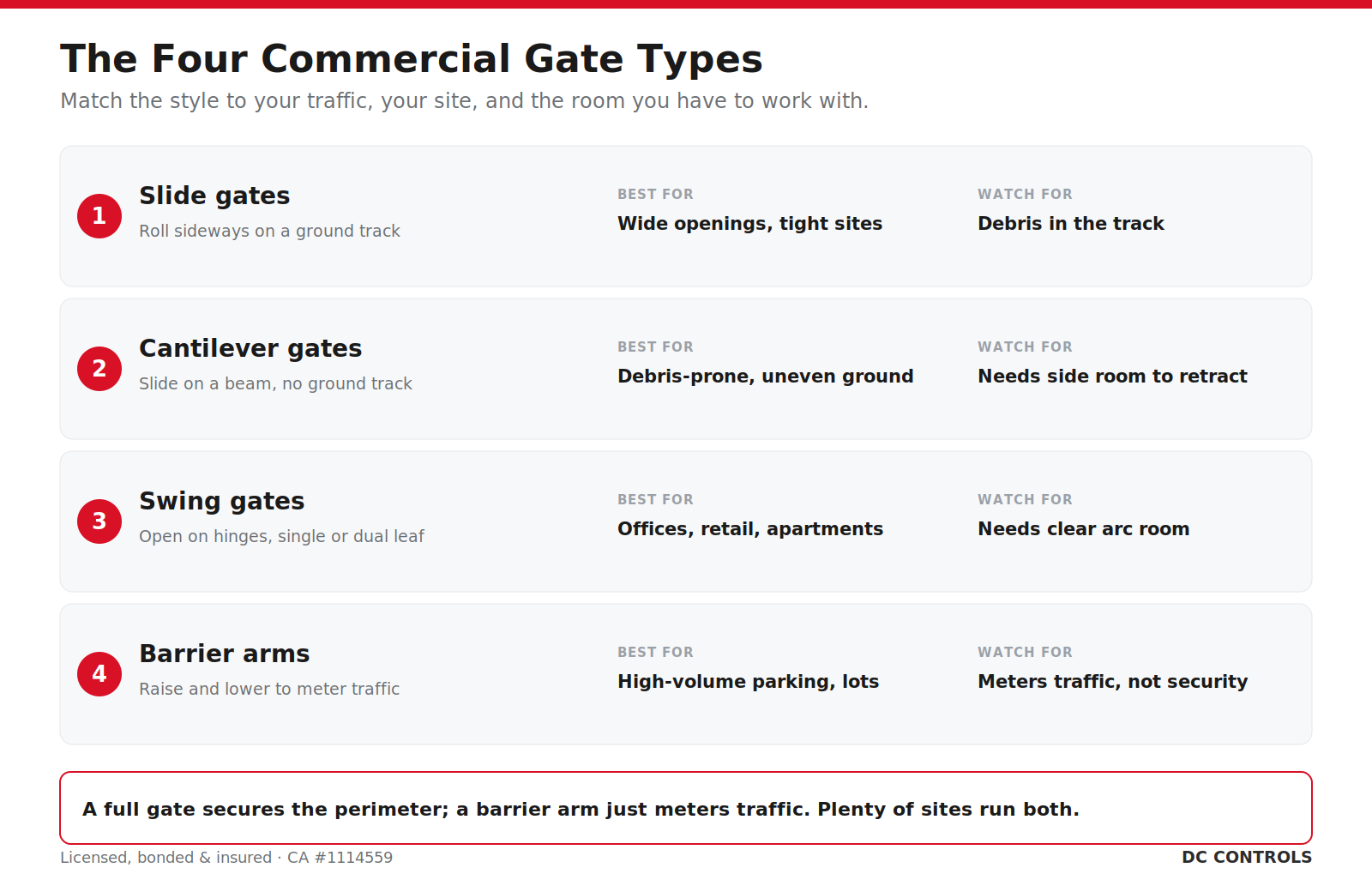
Slide gates roll sideways on a track across your opening. They're a workhorse for wide driveways and spots where a swinging gate would eat up room you don't have. The tradeoff is the ground track. It needs to stay clear, so if your site collects leaves, gravel, snow, or runoff, a track can become a maintenance headache.
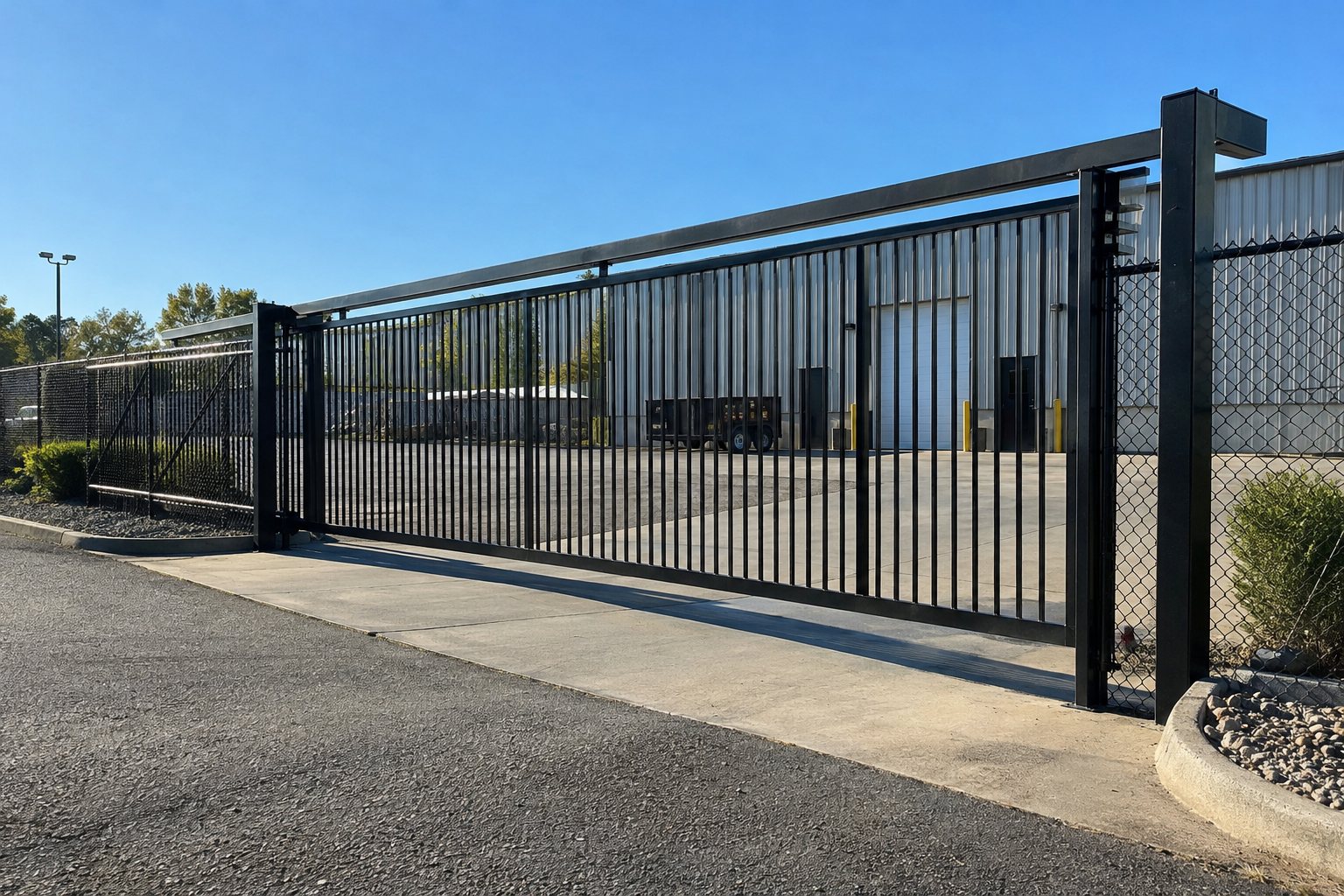
Cantilever gates solve that exact problem. They slide too, but they're suspended on an overhead beam and counterbalanced, so there's no ground track at all. Nothing to jam, nothing to sweep out. That makes them a strong pick for uneven ground, industrial yards, and any site where debris is a fact of life. They need some clearance alongside the opening for the gate to retract into, so they work best where you've got room to one side.
Swing gates are the classic look, and for a lot of offices, retail centers, and apartment entrances they're the right call. They open into or away from the property on hinges. Single-swing works for narrower openings, and a split dual-swing covers wider ones while keeping each leaf a manageable size. The thing to watch is clearance. A swing gate needs arc room, and it doesn't love a steep grade or a tight driveway where cars stack up.
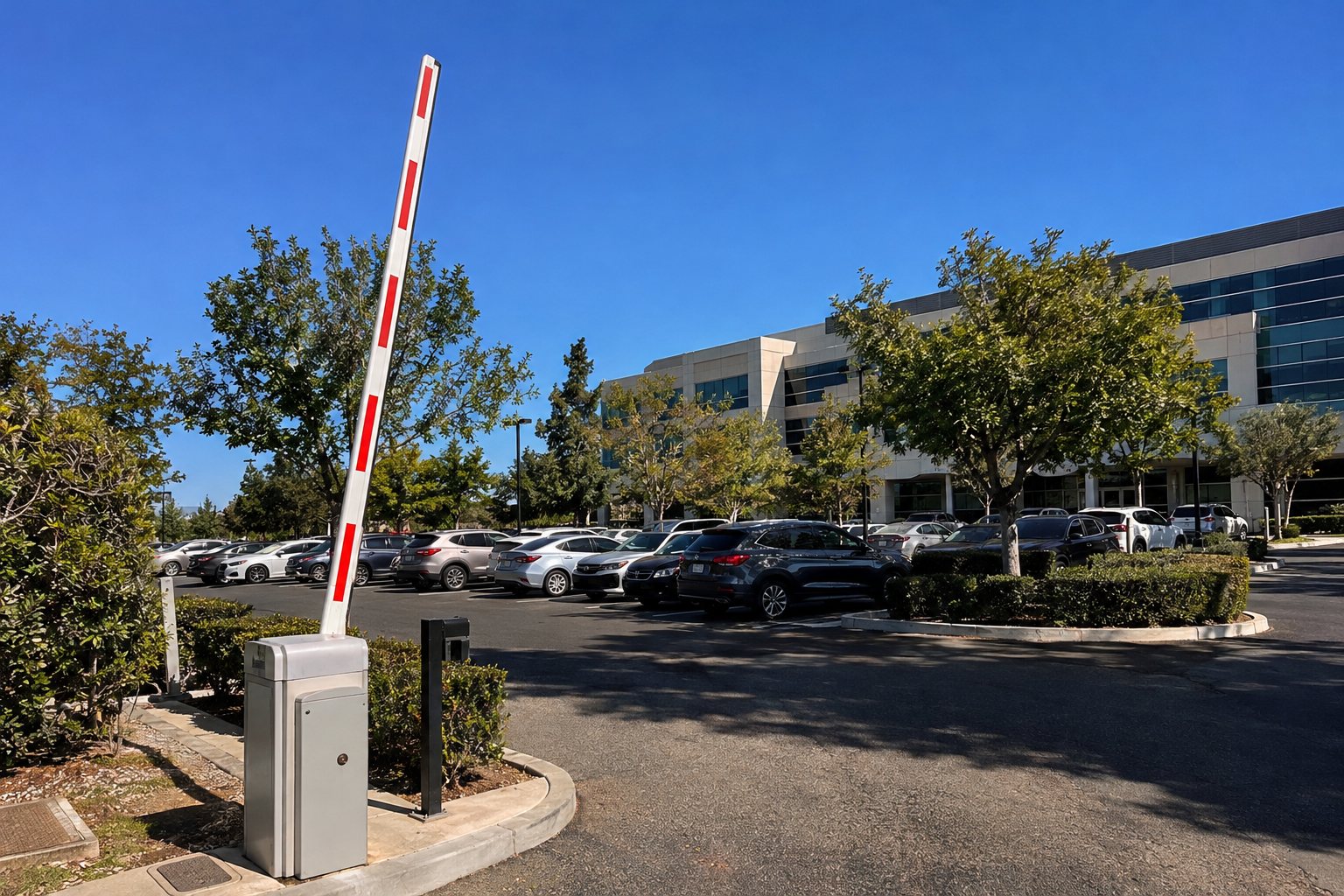
Barrier arms are a different animal. They don't secure a perimeter the way a full gate does, they control traffic flow. They go up and down fast, which makes them ideal for high-volume parking structures, employee lots, and anywhere you're metering a lot of vehicles quickly rather than keeping people out. Plenty of properties run a barrier arm for daily car traffic and a slide or swing gate for actual after-hours security.
Why a Commercial Gate Is Built Differently Than a Residential One
The visible difference is size. The real difference is duty.
A residential gate operator is engineered for light use. Point it at a commercial opening and it'll burn out, because commercial gates face heavier cycling, wider and heavier spans, and operators rated for continuous duty. When we spec a commercial job, the operator's duty rating is one of the first things on the table, right next to opening width and how fast you need the gate to move. A faster gate costs more and asks more of the hardware, but at a busy entrance a slow gate means a line of cars, which is its own kind of problem. (If you want the full breakdown, here's how to choose and size a gate operator.)
Weight matters too. Commercial gates are bigger and heavier, which changes the hinges, the rollers, the posts, and the footings underneath. This is where cutting corners shows up a year later as a sagging gate or a chewed-up operator. It's also why keeping up with service matters so much on a commercial gate, and here's what actually wears a gate operator out, and the warning signs to watch for.
Access for Employees, Visitors, and Deliveries
You don't need to overthink this during gate selection, but it shapes the layout. Most commercial sites juggle three groups: employees who come and go daily, visitors who need a way to call in, and deliveries that show up on their own schedule. That usually points toward a mix, say a reader or code for staff and a call box for everyone else. We flag it early because the number of lanes and where the operators sit affects which gate style actually fits. Beyond that, access control is its own conversation.
UL 325, ASTM F2200, and What Safety Actually Requires
Commercial automation has real safety standards behind it, and this is not the place to improvise. Gate operators we install are UL 325-listed, and a listed operator has to be paired with the required monitored entrapment-protection devices, such as photo eyes and/or gate edges, so the gate reverses instead of crushing a vehicle or a person. The gate's physical construction follows ASTM F2200, which governs how the gate itself is built so there's nothing to reach through or get caught on.
Two honest caveats. UL 325 covers the operator and the system around it, it does not certify the gate as a whole or act as a blanket legal mandate on its own. And permitting and inspection requirements vary by jurisdiction, so what the City of Sacramento, the county, or your specific municipality asks for isn't identical everywhere. Part of our job is knowing which rules apply to your address before anything gets poured or wired.
Why One Accountable, Licensed Team Matters on a Commercial Job
A commercial gate is rarely just a gate. There's concrete for the posts and the operator pad, electrical to run power and low-voltage, the gate fabrication itself, and the permit and inspection side. When those pieces are split across three or four subcontractors, the gaps between them are where projects stall and nobody owns the problem.
We handle design, fabrication, installation, and service in-house, no subcontractors, which means one team is accountable from the first site walk to the final inspection. We're a licensed California contractor (CA #1114559), carry a $25,000 contractor's bond, and are workers' comp insured, with a BuildZoom vetting score of 93. Our techs are factory-trained on LiftMaster, DoorKing (DKS), HySecurity, and Viking, so the operator we recommend is one we actually know how to service, not just sell, and one we can actually diagnose when something goes wrong. For context, we're family-owned and second-generation, based in Loomis and serving the greater Sacramento region for more than 25 years.
Frequently Asked Questions
What type of commercial gate is best for a busy entrance?
For wide openings with heavy daily traffic, a slide or cantilever gate is usually the best fit, because it handles continuous cycling and wide spans. Cantilever gates suit debris-prone or uneven sites since they have no ground track. Swing gates work well for offices and retail with moderate traffic and room for the gate to arc.
What's the difference between a commercial and residential gate operator?
Mainly duty cycle and build. Commercial operators are rated to run far more cycles per day, continuously, without overheating, and they move heavier, wider gates. A residential operator put on a commercial opening wears out early.
Does a commercial gate have to meet safety codes?
Yes. Gate operators should be UL 325-listed and paired with monitored entrapment-protection devices like photo eyes or gate edges, and the gate itself should be built to the ASTM F2200 construction standard. Permitting requirements vary by jurisdiction, so the exact rules depend on your address.
How long does a commercial gate installation take?
It depends on the gate type, site prep, concrete, and electrical, but most commercial jobs run from a few days to a couple of weeks once permitting and fabrication are done. We give you a real timeline after walking the site.
Let's Look at Your Site
If you're weighing a new commercial gate or replacing one that can't keep up, the fastest way forward is to have us walk the property. We'll look at your traffic, your opening, your grade, and your security needs, then tell you straight which gate makes sense. Reach out for a free on-site consultation anywhere in the greater Sacramento region.


