
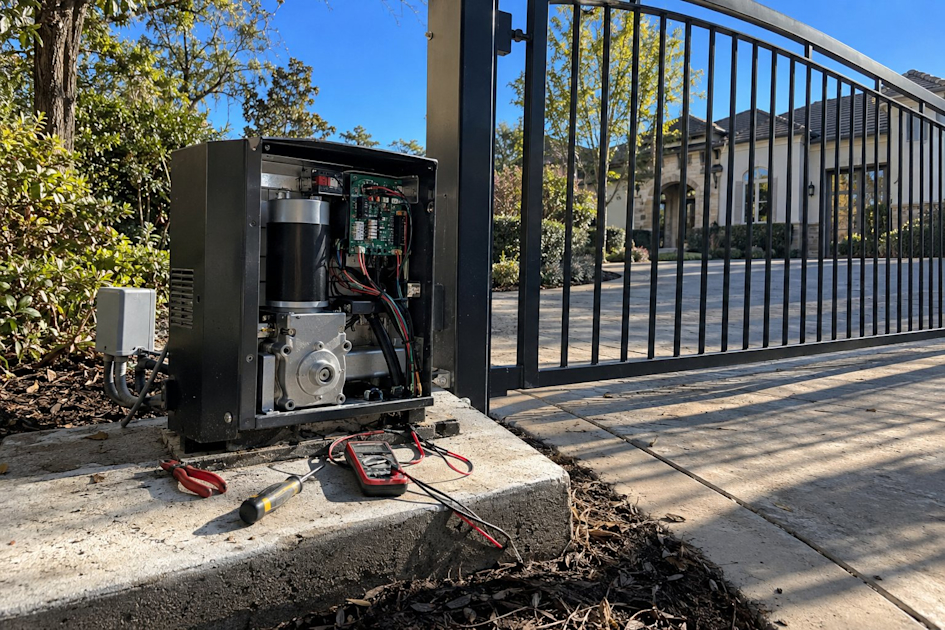


The short version: An automatic gate is a gate plus an operator, and the operator wears out first. In our climate, summer heat cooks the control board, dust grinds the moving parts, and rodents chew the wiring, while batteries are a wear item that will eventually die. Keep the track clean, watch for slow, noisy, or hesitating operation, and get a pro service once or twice a year before a cheap tune-up turns into a dead operator.
Most people don't think about their automatic gate until the morning it won't open. You pull up, hit the remote, and nothing. Or it starts to move and then stutters back closed like it changed its mind. That failure almost never comes out of nowhere. The gate was telling you for weeks, you just weren't listening for it.
An automatic gate is really two systems bolted together. There's the gate itself, the frame and the hinges or rollers, and there's the operator, the motor and brains that move it. The operator does the work hundreds of times a week, and it's the part that wears out first.
The Operator Does the Heavy Lifting, and It Shows
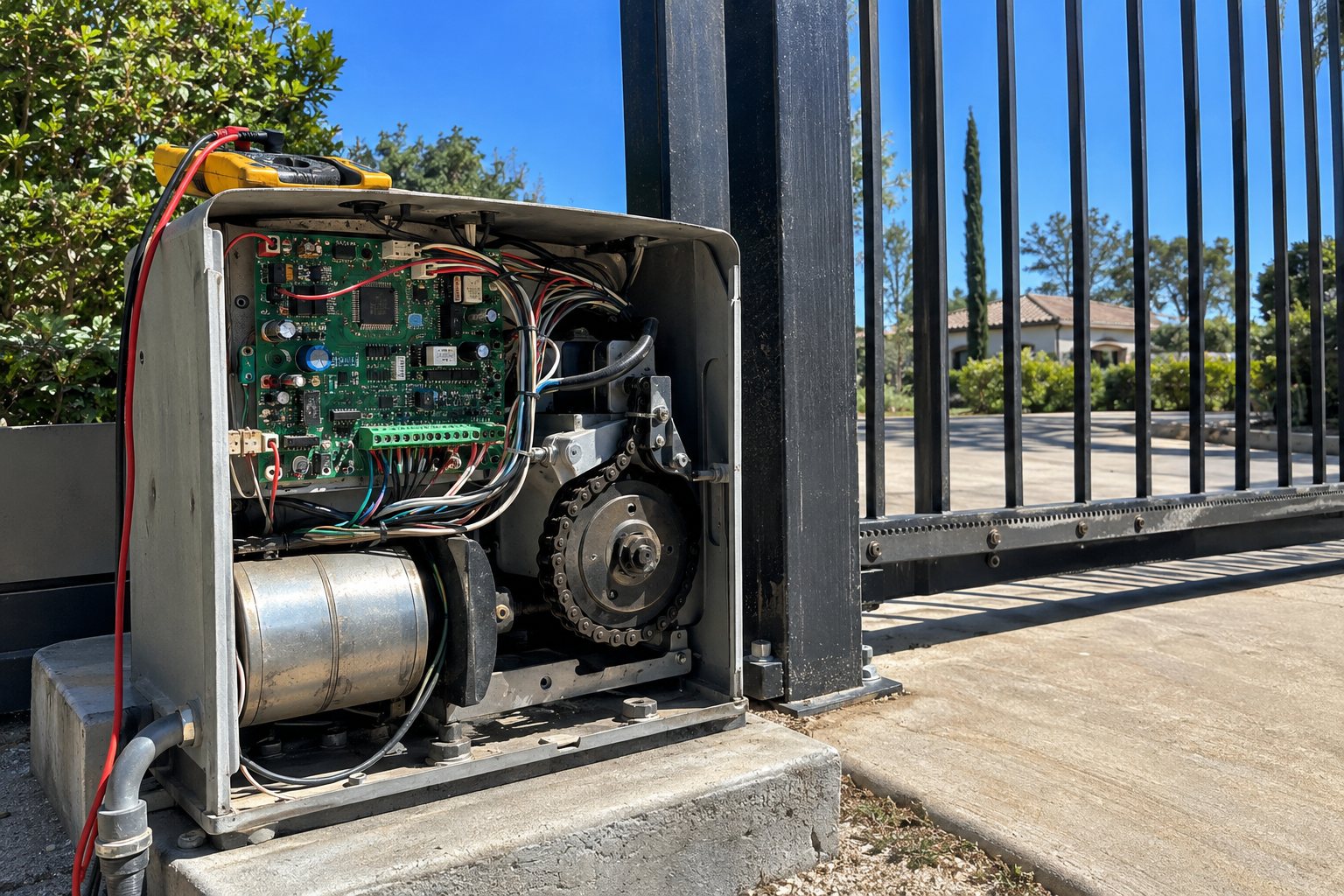
Inside that operator housing you've got moving parts doing the same motion over and over. On most operators that means a gearbox, and on a lot of residential and light-commercial units a chain or belt drive. Gears wear, chains stretch, belts crack and glaze over. Every cycle adds up, and a gate on a busy driveway cycles a lot more than you'd guess.
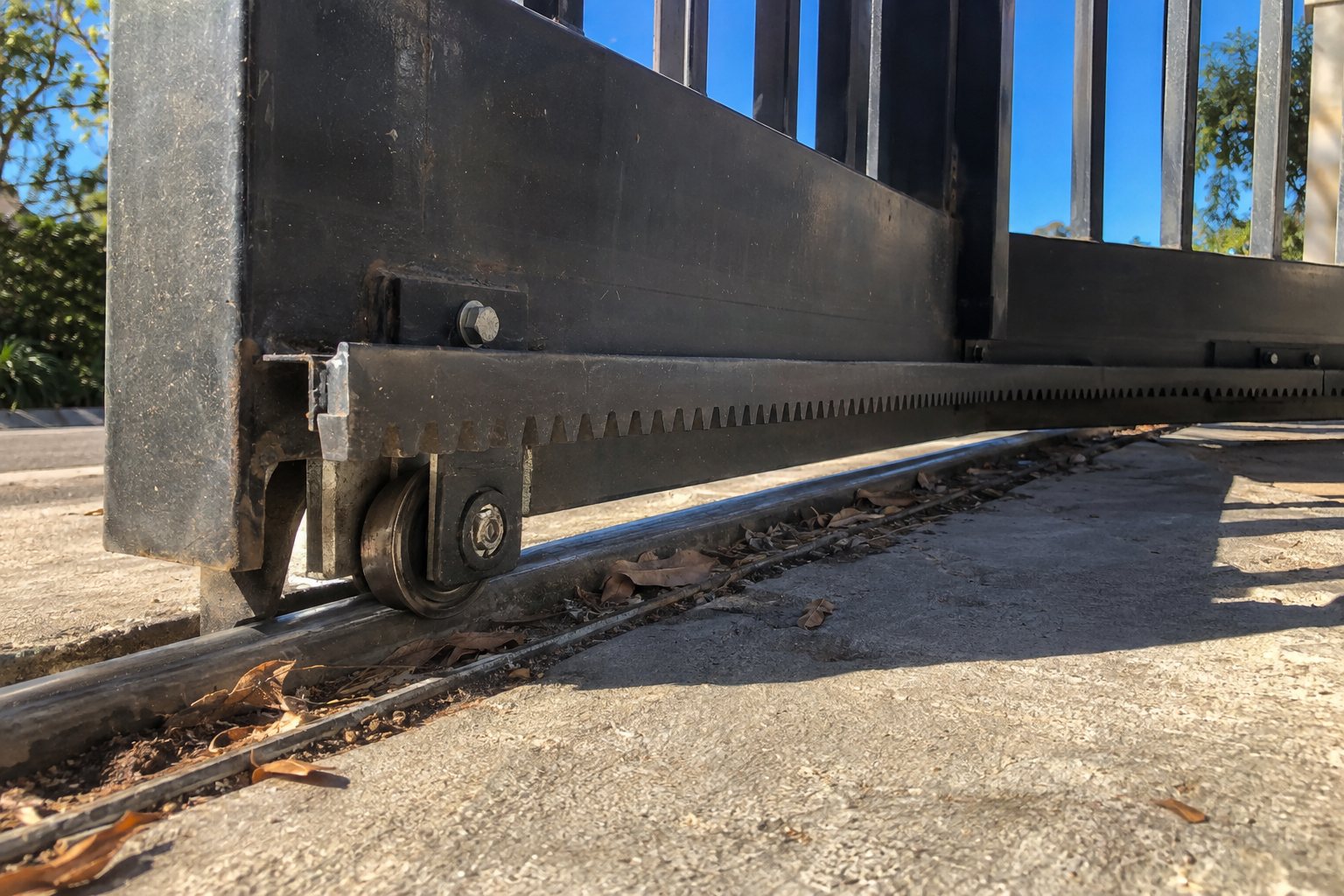
Slide gates have their own wear points. The gate rides on a drive rack and rolls on wheels and guide rollers. When that rack gets packed with dirt, or a roller starts to bind, the operator has to fight for every inch. It pushes harder, draws more current, and runs hotter, and that extra strain is what shortens a motor's life. Swing gates lean on their hinges and arms instead, so if a hinge sags or a post shifts, the gate goes out of square and the motor strains against geometry instead of just moving a gate.
Sacramento Heat, Dust, and Rodents Are Hard on Gates
Our climate is genuinely rough on this equipment, in a few specific ways.
Summer heat is the big one. A control board is a circuit board, and circuit boards hate heat. Pair 100-plus degree afternoons with an operator sitting in full sun and you're cooking electronics all day, which is why a gate that's been fine for years suddenly gets flaky in August. Dust is constant out here, and that fine grit works its way into the track, the gear teeth, and the housing, turning a smooth glide into a grind.
Rodents are the one nobody expects. Out in the foothills and on acreage, mice and rats love a warm operator box and chew low-voltage wiring like it's their job. A perfectly healthy gate goes dead or starts behaving randomly, and the culprit is a chewed wire to a safety sensor. Power surges matter too, since rural power can be dirty, and winter moisture gets into connections that spent all summer drying out and cracking.
Batteries Are a When, Not an If
If your gate runs on solar or has a battery backup, those batteries have a finite life and they will die. That's not a defect, it's chemistry, and heat speeds it up. A lot of "my gate randomly stopped" calls trace back to a battery that quietly gave up. If your system depends on one, treat it as a wear item you replace on a schedule, not something that lasts forever.
What You Can Handle, and What You Really Shouldn't
A fair amount of upkeep is genuinely homeowner-level. Keep the track and the area around the operator and photo eyes clean, clear leaves and weeds, and walk the gate every so often looking for a wobbling wheel, a rusting hinge, or a chewed wire. Watch and listen when it runs, because you know what normal sounds like.
Leave anything inside the housing or involving the safety system to a pro. Adjusting force settings, aligning photo eyes, servicing the drive, diagnosing a board, re-tensioning a chain, those are jobs where guessing can hurt someone or wreck the operator. One hard line: never bypass or disable your photo eyes to get the gate working. Those are the monitored entrapment-protection devices that stop a gate from closing on a car, a pet, or a kid, and the operators we install are UL 325-listed and built to run with them in place.
The Warning Signs That Mean It's Time to Call
Your gate will tell you it's struggling. Call for service when you notice any of these:
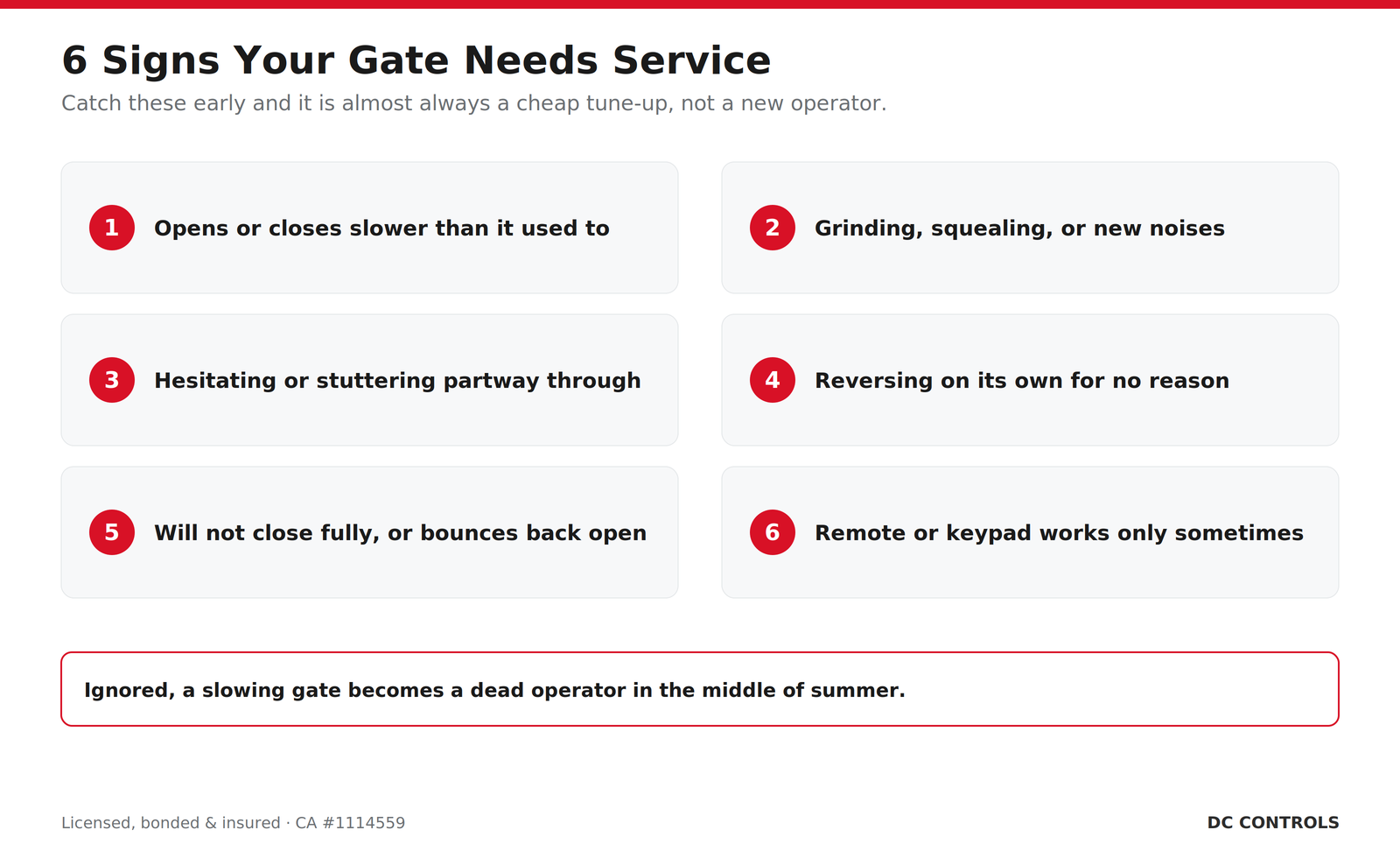
- Opening or closing noticeably slower than it used to
- Grinding, squealing, or new clunking noises
- Hesitating or stuttering partway through
- Reversing on its own for no obvious reason
- Not closing all the way, or bouncing back open
- Remotes or the keypad working only sometimes
A sensor alignment, a cleaning, a tensioned chain, or a fresh battery are small fixes. A failed operator you ran into the ground is not. Catching wear while it's still just wear is almost always the cheaper path. If yours is already acting up, our brand-by-brand troubleshooting guide walks through what to check first.
Frequently Asked Questions
How often should an automatic gate be serviced?
Once or twice a year for most gates, and more often if it runs heavy traffic or sits in a dusty or rural spot. Regular service is the single biggest factor in how long an operator lasts.
Why did my gate suddenly stop working in summer?
Heat is hard on the control board, and a hot operator sitting in full sun can push a marginal board or a tired battery over the edge. A lot of mid-summer failures trace back to the board or the battery.
How long do gate operators and their batteries last?
A well-maintained operator can run for many years, but batteries are a wear item that need replacing on a schedule, and heat shortens their life. Expect to replace a backup or solar battery periodically, not never.
What gate maintenance can I do myself?
Keep the track and the area around the operator and photo eyes clean, clear weeds and debris, and watch and listen for changes. Leave anything inside the housing or involving the safety system to a technician, and never bypass a photo eye.
Keep Your Sacramento-Area Gate Running Right
We do gate operator maintenance and service across the greater Sacramento region, and we handle our own work in house from diagnosis to repair, factory-trained on LiftMaster, DoorKing, HySecurity, and Viking. If your gate is showing any of the signs above, or it's just been a while, reach out to DC Controls in Loomis and we'll get it looked at before it turns into a replacement.


