


Quick answer: Yes — solar gate openers work very well in Sacramento. A small solar panel keeps a battery charged so the opener runs day and night, even through cloudy stretches. With 260+ sunny days a year, they're an excellent fit here, especially for rural gates that sit far from power. The two things that decide whether solar is right for you are how far your gate is from an electrical panel and whether the panel gets a few hours of unshaded sun.
Plenty of properties in Wilton, Loomis, Shingle Springs, and up into the El Dorado foothills have a driveway gate sitting hundreds of feet from the nearest electrical panel. Trenching power out to it — cutting across a long dirt or paved driveway, pulling permits, running conduit — can cost more than the gate itself. That's where solar earns its keep. In 25+ years automating gates across the region — as a licensed General “A” & “B” contractor (C-61/D28 and C-13, CA #1114559) — solar is the option we reach for most on rural lots, and it's also the one homeowners most often get wrong when they buy an off-the-shelf kit. Here's how it actually works, how we size it, and how to tell if it fits your property.
How does a solar gate opener work?
It's simpler than it sounds. A solar panel charges a rechargeable battery through a charge controller, and the battery — not the sun directly — powers the gate motor through the control board. That's the key point people miss: the gate runs off stored energy, so it opens reliably at night, at dawn, and through a run of gray days. The sun's only job is to top the battery back up between cycles.
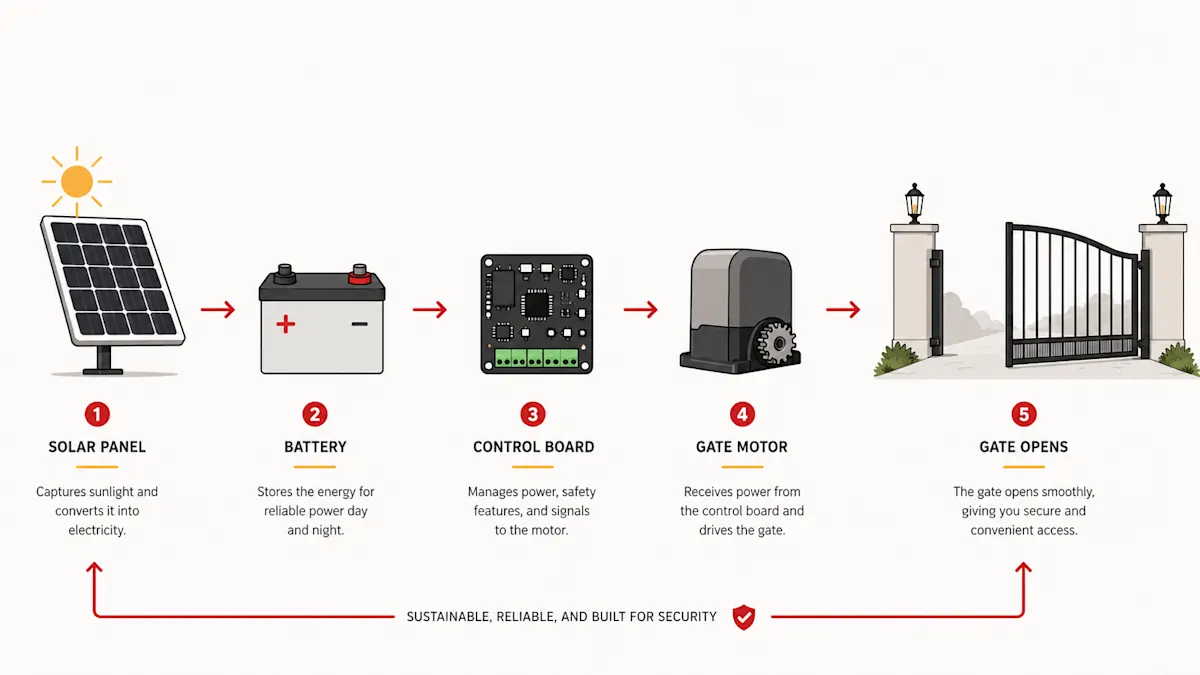
Because they run on stored DC power, solar gates use low-current operators built for the job — not the same high-draw motors you'd hang on a hardwired commercial gate. Matching the operator to the gate is where a professional install separates itself from a kit. For a deeper look at the motors and control boards involved, see how automatic driveway gates work.
Is a solar gate opener right for my property?
Before we quote a solar system, we look at four things on site. They decide almost everything about whether solar is the smart call and how big it needs to be:
- Distance from power. If your panel is close to the gate, hardwired is often simpler. Once trenching gets long — say past 100–150 feet — solar usually wins on cost.
- Sun exposure at the gate. The panel needs a few hours of direct, unshaded sun. This is the single biggest issue in the foothills, where oak canopy can shade an entrance for half the day.
- How often the gate cycles. A quiet residential driveway might open 10–20 times a day; a shared ranch road or a home with teenagers and deliveries can hit 40+. Cycles drive the panel and battery size.
- Gate weight and type. A big solid privacy gate takes more energy to move than an open picket gate, so it needs a larger system — and sometimes tips the decision back toward hardwired.
How much sun does a solar gate opener need?
Less than most people expect — but placement matters more than raw hours. A properly sized panel in Sacramento sun easily supports a typical residential gate. As a rough guide:
- Light use (10–20 cycles/day): a small 10–20W panel is usually plenty.
- Heavy use (40+ cycles/day, or a large/heavy gate): a larger panel and battery, or a hybrid with a trickle charger.
- Shade beats clouds as the real enemy. A cloudy day still delivers charge; a tree shadow across the panel for six hours does not. We aim the panel south, keep it clear of canopy, and sometimes mount it on a separate post in the sun rather than on the gate itself.
Do solar gate openers work in winter or on cloudy days?
Yes — this is what the battery is for. We size the battery to hold several days of reserve, so a stretch of gray Sacramento winter won't leave you stranded at the end of your driveway. The math is straightforward: we estimate your daily cycles, calculate the energy each cycle draws for your specific gate, then size the battery to carry several days of that load with no charging at all. Get the sizing right and winter is a non-event. Get it wrong — which is what most kits do — and you're jump-starting a dead gate battery in January.
Solar vs. hardwired: which should you choose?
| Solar | Hardwired | |
|---|---|---|
| Best for | Gates far from power, rural lots | Gates near an existing panel |
| Install cost | Lower if trenching would be long | Higher if trenching is required |
| Ongoing | Battery swap every few years | Minimal |
| Sun/shade dependent | Yes — placement is critical | No |
| Heavy/commercial use | Possible with larger system | Simplest for high cycle counts |
Mistakes we see with DIY solar gate kits
Solar kits sell a fantasy of "mount it and forget it." Here's what actually brings us out for a service call:
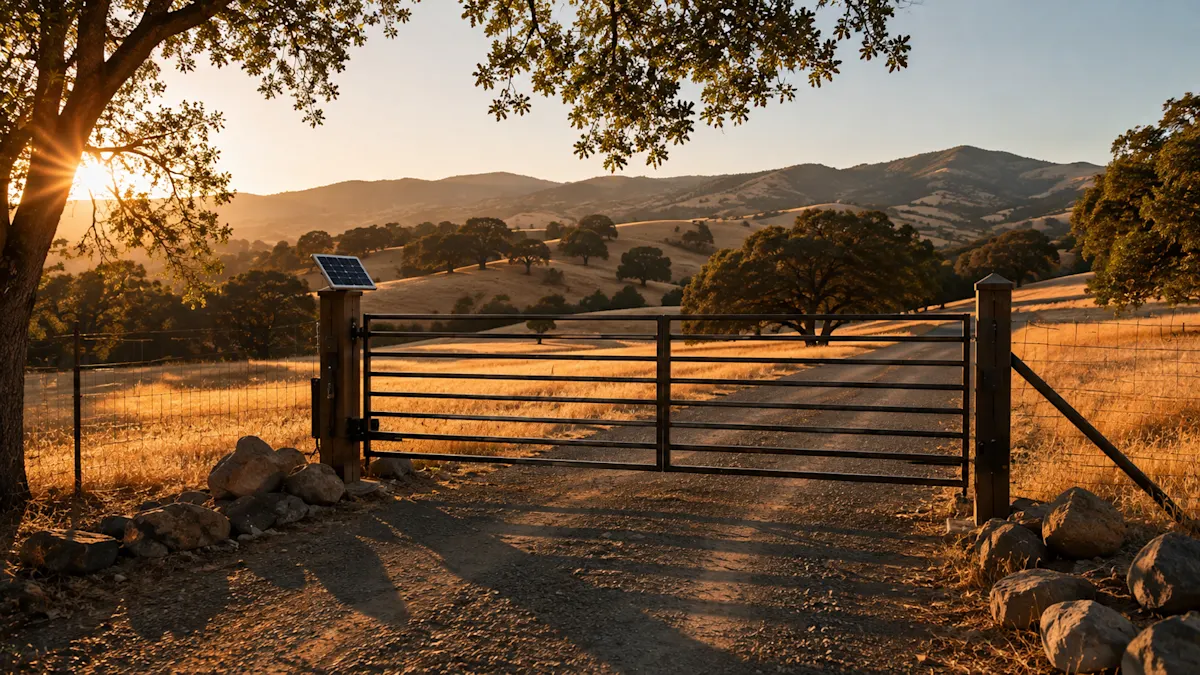
- The panel is in the shade. It's mounted on the gate post under the very oak trees that made the lot beautiful. The battery slowly starves and dies weeks later, and nobody connects the two.
- The system is undersized for the gate. A kit rated for a light aluminum gate gets bolted to a heavy solid one. It works in July, then can't keep up once the days shorten.
- No safety devices. Solar doesn't exempt a gate from the UL 325 safety standard. It still needs photo eyes and, in many cases, loop detectors so it can't close on a car, a pet, or a child.
- The battery cooks in a sealed box in full sun. Heat is what kills gate batteries in this climate. We mount and ventilate the battery enclosure to protect it from our summer temperatures.
- No manual release plan. Every gate we install has a key release so you're never locked out if a battery ever does fail.
Best for rural & off-grid Sacramento properties
If your gate is far from power, solar is usually the most cost-effective path to a fully automatic gate — and on a long foothill driveway, it's often the only practical one. We size the panel, charge controller, and battery to your exact gate, cycle count, and sun exposure, place the panel where it'll actually collect, and add the safety and access hardware to match. Explore solar gate opener installation or general gate opener installation.
Frequently asked questions
How long does the battery last?
Typically 3–5 years before replacement, depending on cycles and heat. Sacramento's summer temperatures are hard on batteries, which is why we mount and ventilate the enclosure carefully — it's a big factor in how long a battery lasts here.
What happens during a week of rain?
Nothing, if the system is sized right. The battery carries several days of reserve on its own, and even overcast days still deliver some charge. Correct sizing is the whole game — it's what a kit can't do for your specific gate.
Can I still get in if the battery ever dies?
Yes. Every gate we install includes a manual key release so you can open it by hand. You're never stranded outside your own property.
Can I add solar to my existing gate?
Often yes — many existing swing and slide gates can be retrofitted with a solar-compatible opener, as long as the gate's weight suits a low-current operator. Ask for a free on-site assessment and we'll check the sun exposure at the same time.
What does a solar gate opener cost installed?
It varies with gate size, cycle count, and system capacity; see our driveway gate cost guide for ranges, or request a quote.


