
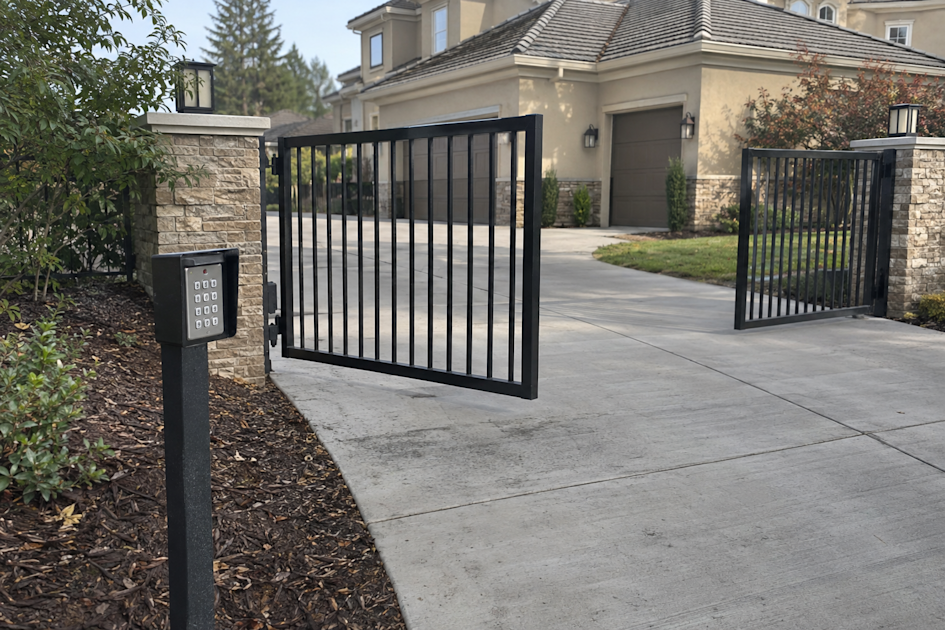


Quick Answer: Automatic driveway gates operate by using an electric gate operator (motor) to physically move the gate, powered by electricity and controlled by an access device like a remote or keypad. Safety sensors, such as photo-eyes and sensing edges, ensure the gate opens and closes without obstruction, adhering to strict UL 325 safety standards.
The Core Components of an Automatic Gate System
An automatic driveway gate system is a sophisticated assembly of interconnected parts, each playing a crucial role in its safe and efficient operation. At DC Controls, we’ve installed countless systems across the Sacramento area, and while every setup is unique, they all share these fundamental components.
The Gate Operator (Motor)
The heart of any automatic gate system is the gate operator, often referred to as the motor or opener. This electromechanical or hydraulic unit provides the power to physically open and close the gate. Operators are specifically designed for either swing gates (which pivot open like a door) or slide gates (which move horizontally along a track or cantilever).
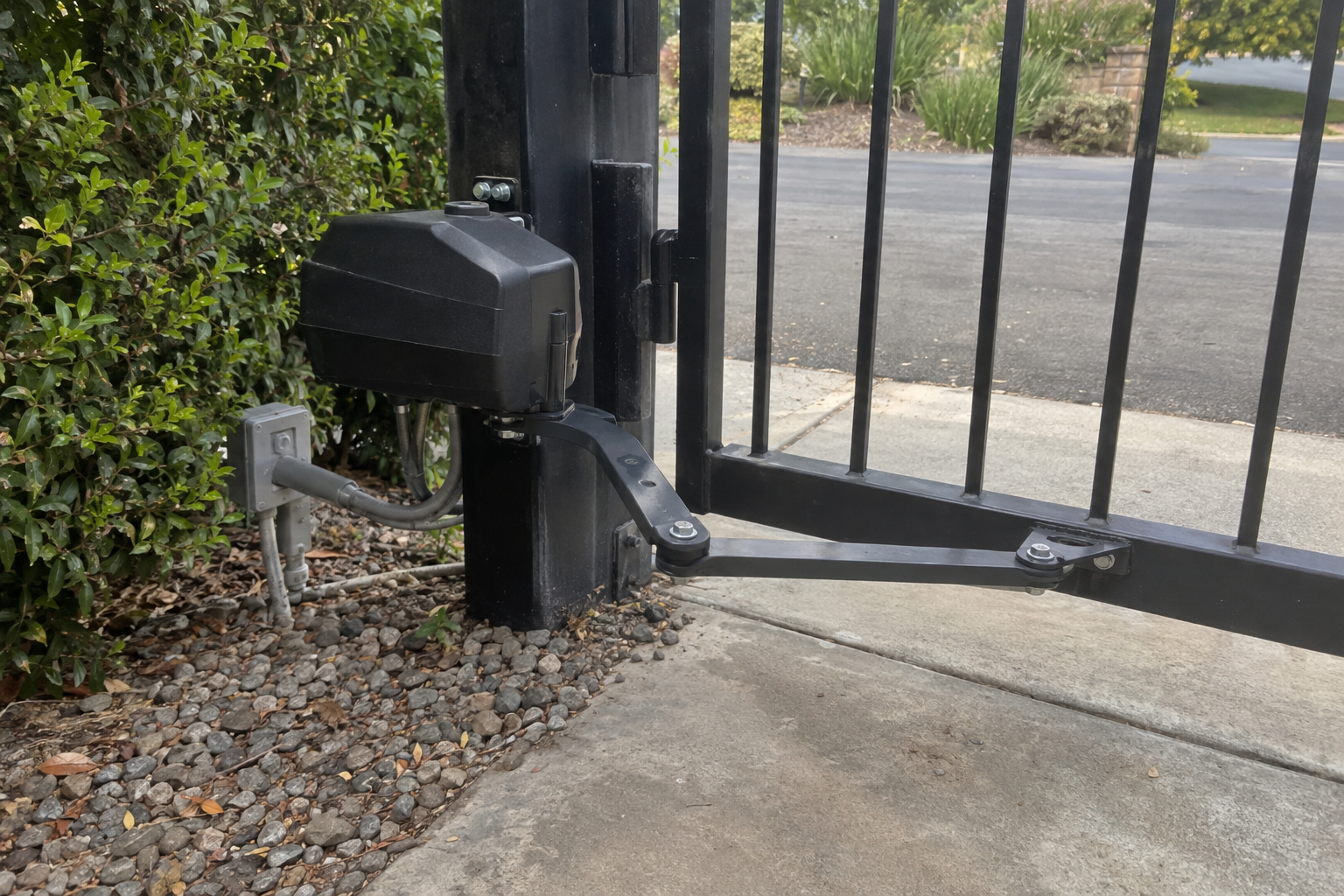
For swing gates, operators like the LiftMaster LA412 or DoorKing 9100 might use an articulated arm, a ram-style piston, or be underground. Slide gate operators, such as the LiftMaster LA500 or HySecurity SlideDriver, typically use a gear and chain/rack system to pull the gate along. The operator receives commands from your access control system and performs the physical movement, often with adjustable speed and force settings.
Power Source
Every automatic gate operator requires a reliable power source. Most residential systems run on low-voltage DC (direct current) power, often supplied by a transformer that converts standard 120V AC household current. Many operators, like the LiftMaster LA500DC, incorporate a battery backup system that charges continuously and provides operation during power outages. This is especially critical in areas like Sacramento, where PSPS (Public Safety Power Shutoff) events can impact power delivery. Commercial and heavy-duty gates might use higher voltage AC (alternating current) directly, or even hydraulic power.
Access Control Devices
These are the “brains” that tell your gate when to open or close. We configure a variety of devices based on your security and convenience needs:
- Remote Controls (Transmitters): Handheld devices that send a signal to a receiver, much like a garage door opener.
- Keypads: Mounted near the gate, requiring a specific code for entry. Popular models include the DoorKing 1838 Telephone Entry System which can also provide communication.
- Intercom Systems: Allow visitors to communicate with occupants before entry, sometimes integrated with video.
- Loop Detectors: Buried under the driveway, these detect the presence of a vehicle, automatically opening the gate for exit traffic or triggering safety features.
- Card Readers/Biometrics: Common in commercial or high-security applications, requiring a card swipe or fingerprint.
- Smartphone Apps: Many modern systems, like those using LiftMaster MyQ technology, allow control and monitoring from your phone.
Safety Devices
Safety is paramount, and automatic gates are governed by strict federal safety standards, primarily UL 325. These devices prevent the gate from closing on people, vehicles, or pets.
- Photo-Eyes (Photocells): These emit an infrared beam across the gate opening. If the beam is broken while the gate is closing, the gate will stop or reverse. We typically install multiple sets to cover different heights.
- Sensing Edges: Pressure-sensitive strips mounted on the gate itself. If the gate makes contact with an obstruction, the edge detects the pressure and signals the gate to stop or reverse.
- Obstruction Sensing: Operators have built-in force sensors that detect unusual resistance during operation. If the gate hits something, the motor will stop or reverse.
- Warning Devices: Strobes or alarms can alert people that the gate is in motion.
How Different Gate Types Operate Automatically
The way an automatic gate moves depends entirely on its design: whether it’s a swing gate or a slide gate. Each type has a distinct operational mechanism and is suited for different property layouts and aesthetic preferences.
Automatic Swing Gates
Swing gates operate much like a regular door, pivoting inward or outward from a hinge point. They require ample clear space for their arc of travel.
- Command Reception: An access control device (e.g., remote, keypad) sends a signal to the gate operator’s control board.
- Operator Activation: The control board activates the gate operator, which is typically an electromechanical arm or ram attached to both the gate post and the gate frame. Some systems use underground operators for a cleaner look.
- Gate Movement: The operator extends or retracts its arm, pushing or pulling the gate open. For double swing gates, two operators work in tandem, or one operator can be linked to pull the second gate.
- Safety Check: As the gate moves, integrated safety features like photo-eyes and sensing edges continuously monitor for obstructions. If an obstruction is detected, the gate stops or reverses.
- Limit Switch Activation: Once the gate reaches its fully open or closed position, internal limit switches (or magnetic sensors) signal the operator to stop, preventing over-travel.
- Secure Closure: When closing, the gate often has a mechanical or electromagnetic lock to secure it in the closed position, adding an extra layer of security.
Swing gates are excellent for properties with wide driveways and sufficient clearance, offering a classic aesthetic.
Automatic Slide Gates
Slide gates move horizontally, typically parallel to a fence or wall. They are ideal for properties with limited swing space or sloped driveways.
- Command Reception: Similar to swing gates, a signal from an access control device initiates the opening sequence.
- Operator Activation: A slide gate operator, such as the HySecurity StrongArm or FAAC 884, is mounted beside the driveway. It has a drive gear that engages with a metal rack attached along the bottom of the gate, or a chain that connects to both ends of the gate.
- Gate Movement: The operator’s motor rotates the drive gear, pulling the gate along its track (V-track) or cantilever system. Cantilever gates, which are suspended and don’t touch the ground, are often preferred in areas with uneven terrain or heavy debris.
- Safety Check: Photo-eyes and sensing edges monitor the gate’s path for obstructions, stopping or reversing the gate if necessary.
- Limit Switch Activation: Magnetic sensors or physical limit switches at either end of the gate’s travel path tell the operator when the gate is fully open or closed, stopping the motor.
- Secure Closure: Slide gates often have a built-in latch or an optional magnetic lock for enhanced security when closed.
Understanding Automatic Gate Operators: AC vs. DC, Hydraulic vs. Electro-Mechanical
Choosing the right gate operator is critical for performance, longevity, and safety. At DC Controls, we analyze your specific needs, gate type, and usage patterns to recommend the best fit, considering factors like power source, duty cycle, and operational mechanism.
AC (Alternating Current) vs. DC (Direct Current) Operators
The primary distinction in power delivery affects performance and features. AC operators draw continuously from mains power and suit high-cycle, continuous-duty commercial gates, while DC operators run from a charged battery — giving smoother soft-start/stop, quieter operation, and continued cycles during a power outage, which makes them the common choice for Sacramento-area residential gates and PSPS resilience.
Ready to Automate Your Driveway Gate?
Whether you’re planning a new automated gate or upgrading an existing one, DC Controls designs and installs complete, UL 325-compliant systems across the Sacramento area. As a fully licensed General “A” and “B” contractor (C-61/D28 and C-13, CA #1114559), we self-perform the electrical, concrete, and structural work in-house and size the operator, safety devices, and access control to your gate and property. Contact us today for a consultation.


