

Quick answer: The right gate operator is set by four things — the gate's type (swing or slide), its weight, its length, and how many cycles per day it will run — not by price. Match those to a model's published rating, leave a buffer, and confirm the power source. Undersizing is the most expensive mistake, because an operator running past its rating wears out early.
Operator size depends on more than gate weight
Weight matters, but length and cycle count matter just as much. A long gate creates leverage that multiplies the force an operator has to overcome, and a gate that cycles dozens of times a day needs a heavier-duty motor than the same gate on a quiet residential driveway. Wind load and slope factor in too. Size to all of it, not just the weight.
Step 1 — Start with the gate type
Gate type dictates the operator family:
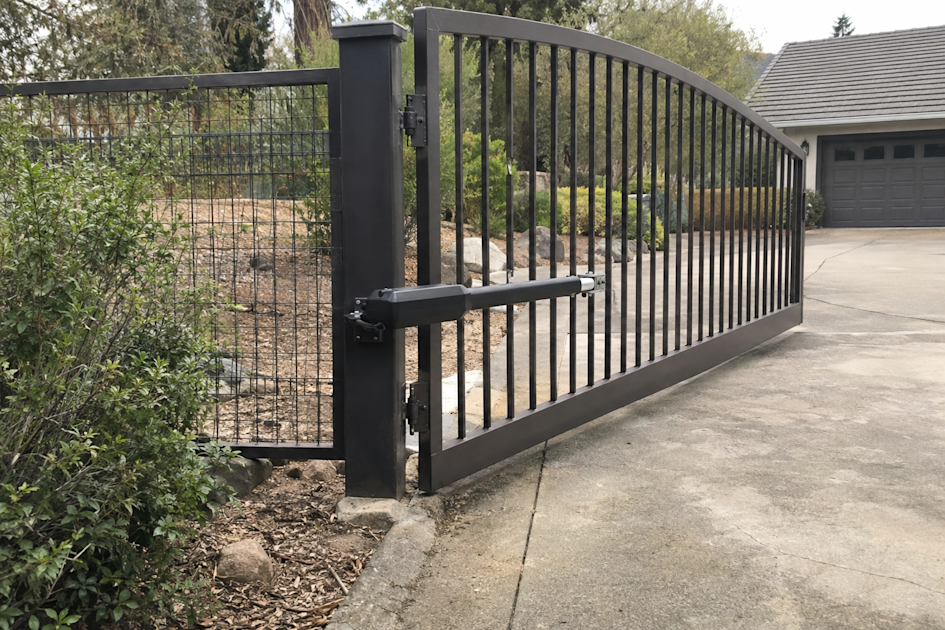
- Swing gates use a linear (arm/ram) or underground operator; dual-swing gates need one per leaf.
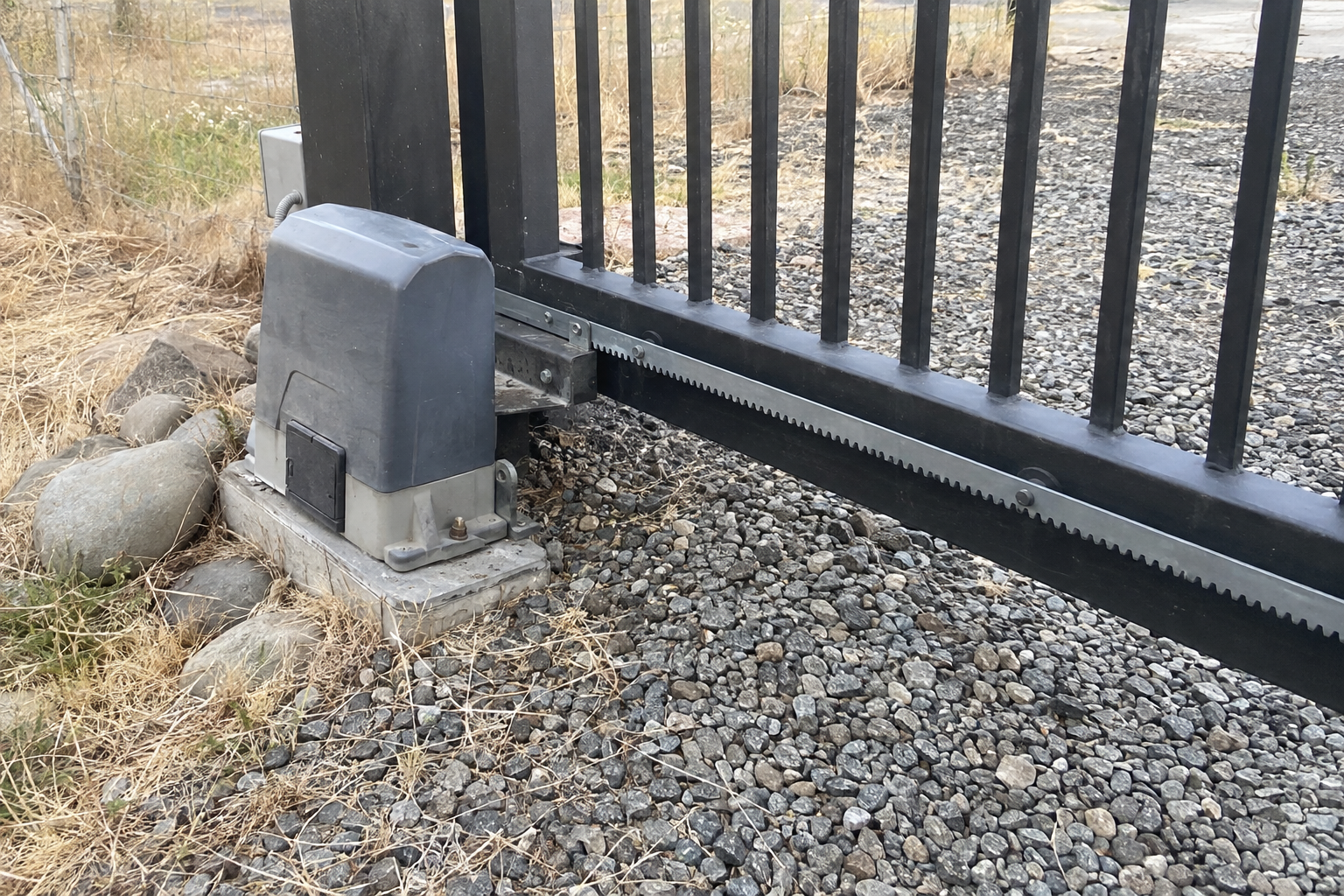
- Slide gates use a rack-and-pinion (or chain) slide operator.
Getting this right first narrows everything else. If a swing gate would need to be longer than about 20 feet per leaf, a slide gate is usually the better mechanical choice.
Step 2 — Weigh and measure the gate
You need the gate's weight and length. As a rough guide, steel runs about 10–15 lb per linear foot, wood about 8–12, and aluminum about 5–7. Most residential gates land between 200 and 800 lb; commercial gates can exceed 2,000 lb. Measure the actual leaf length — don't estimate the opening.
Step 3 — Count the cycles per day
One "cycle" is one open-and-close. Daily cycles are what separate a residential operator from a commercial one:
| Duty class | Cycles/day | Typical setting |
|---|---|---|
| Light | 10–25 | Single residence |
| Medium | 25–50 | Small business, farm, shared drive |
| Heavy | 50–100 | Multi-unit residential |
| Industrial | 100+ | Commercial / high-traffic facility |
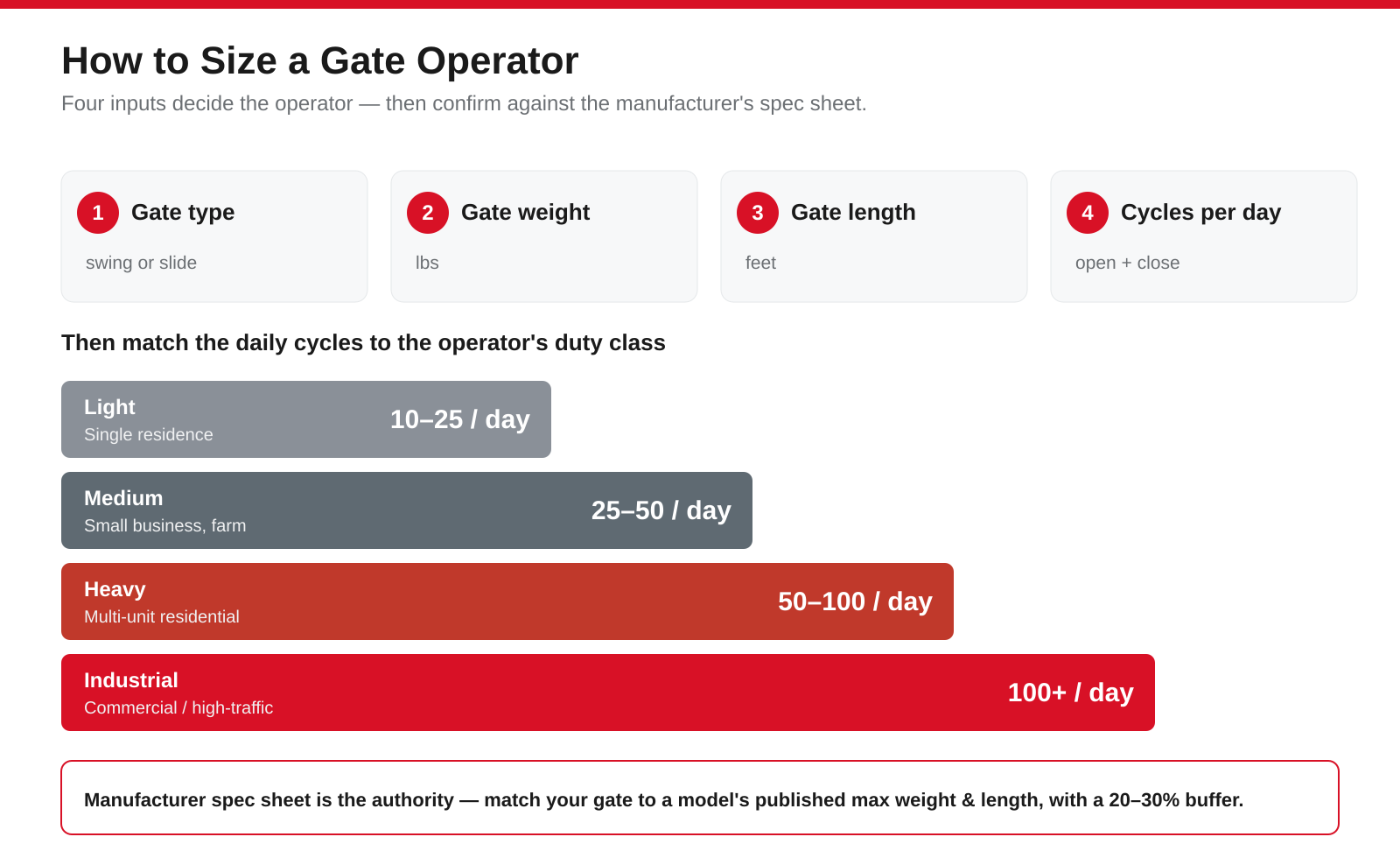
Residential vs. commercial duty cycles
This is where most under-sizing happens. A residential-rated operator on a busy shared or commercial entrance runs hot, works past its designed duty, and fails early. If your cycle count sits near a class boundary, step up — the higher-duty operator costs less than the premature replacement.
Reading a manufacturer spec sheet
The spec sheet is the authority, always. Every operator publishes a maximum gate length and weight — for example, LiftMaster's LA500 is rated for a gate up to 18 ft and 1,600 lb per leaf, runs on 24VDC, and is solar-ready for residential/light-commercial use. Match your measured gate to a model whose published rating clears it with roughly a 20–30% buffer, and confirm the voltage and power option. Don't rely on a rule of thumb where a published number exists.
Where the brands fit
DC Controls is factory-trained on LiftMaster, DoorKing, HySecurity, and Viking. None of these is simply "the residential brand" or "the industrial brand" — each makes operators across several duty classes. Choose by the specific model's published rating and intended application, not by the name on the box. The right question isn't "which brand," it's "which model clears my gate's weight, length, and cycles with margin."
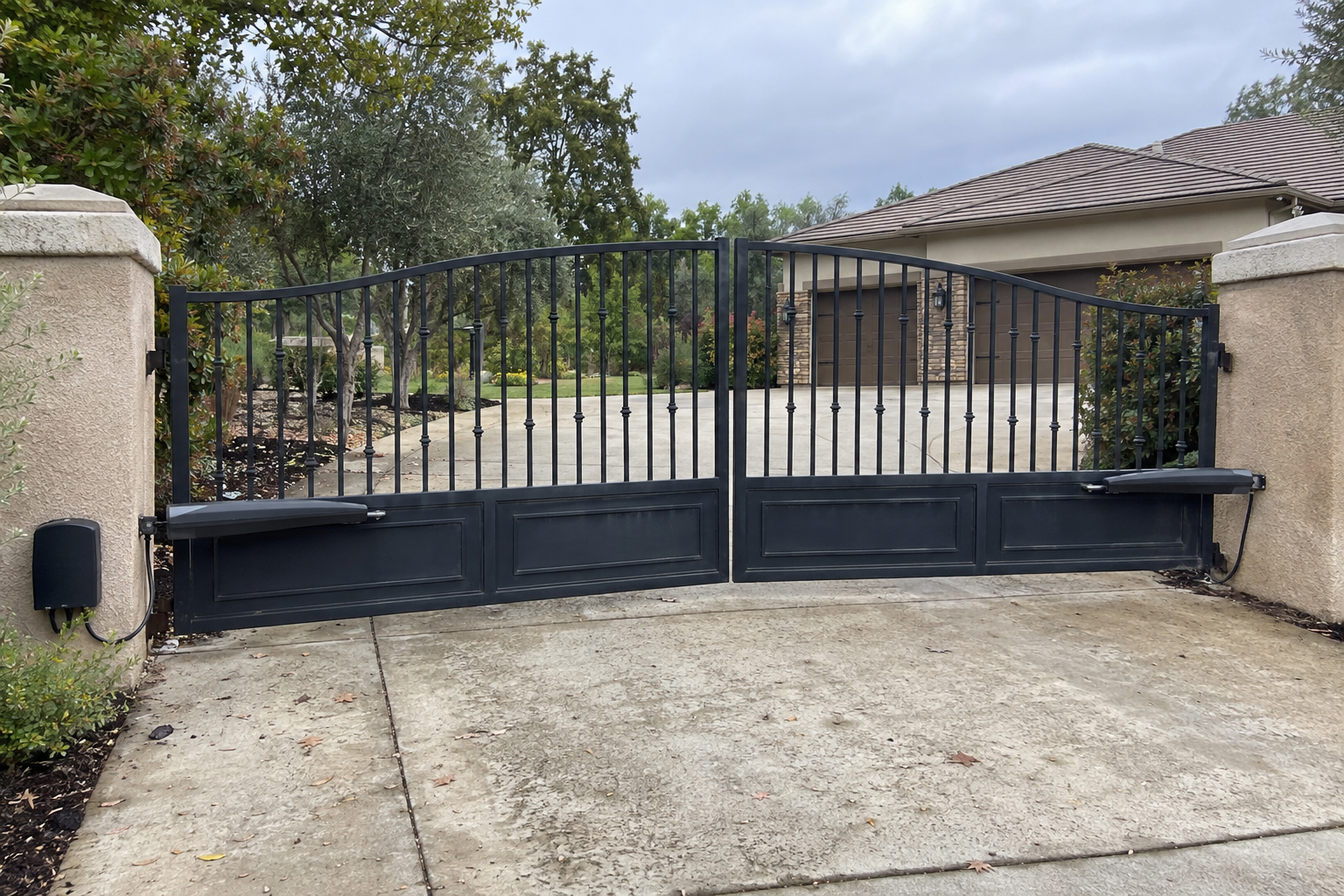
Power: AC, DC, battery backup, and solar
- AC operators run on mains power and suit high-cycle, continuous-duty settings.
- DC operators run from a charged battery and commonly include battery backup, so the gate keeps working through an outage — useful during PSPS events.
- Solar is an option when running power to the gate is impractical; it has to be sized to your sun exposure and daily cycles. See solar gate opener installation.
Do I need a professional to size it?
For a light residential swing gate, the steps above get you close. For heavy, long, dual, or high-cycle gates — and any commercial system — have it sized professionally, because the cost of an under-sized operator is a burned-out motor and a second install. This is where field experience supplements the spec sheet: matching the operator to the real gate, site, and usage. See gate opener installation.
As a licensed General Engineering (“A”) and General Building (“B”) contractor — also holding the C-61/D28 (Doors, Gates & Activating Devices) and C-13 classifications under CA License #1114559 — DC Controls self-performs the electrical, concrete, and structural work a new operator install needs, in-house, with a single point of accountability.
Frequently asked questions
What size gate opener do I need?
Match the operator's published maximum weight and length to your gate with a 20–30% buffer, then confirm it's rated for your daily cycle count. Gate type (swing vs. slide) determines the operator family first.
How long do gate operators last?
It varies widely with duty and maintenance; running an operator within its rated duty cycle and servicing it annually is the biggest factor in longevity.
Can one operator run a very heavy gate?
Only if the gate is within that model's published weight and length rating. Beyond it, you need a heavier-duty operator — or, for very long gates, a slide configuration.
What's the difference between residential and commercial operators?
Mainly duty cycle and build: commercial operators are made to run far more cycles per day, continuously, without overheating.
Not sure which operator fits your gate?
Send us your gate's type, size, and how often it runs, or request an assessment — we'll size the operator to your gate, site, and usage.


